

The Ouroboros of the lens… Or why food photography risks eating itself
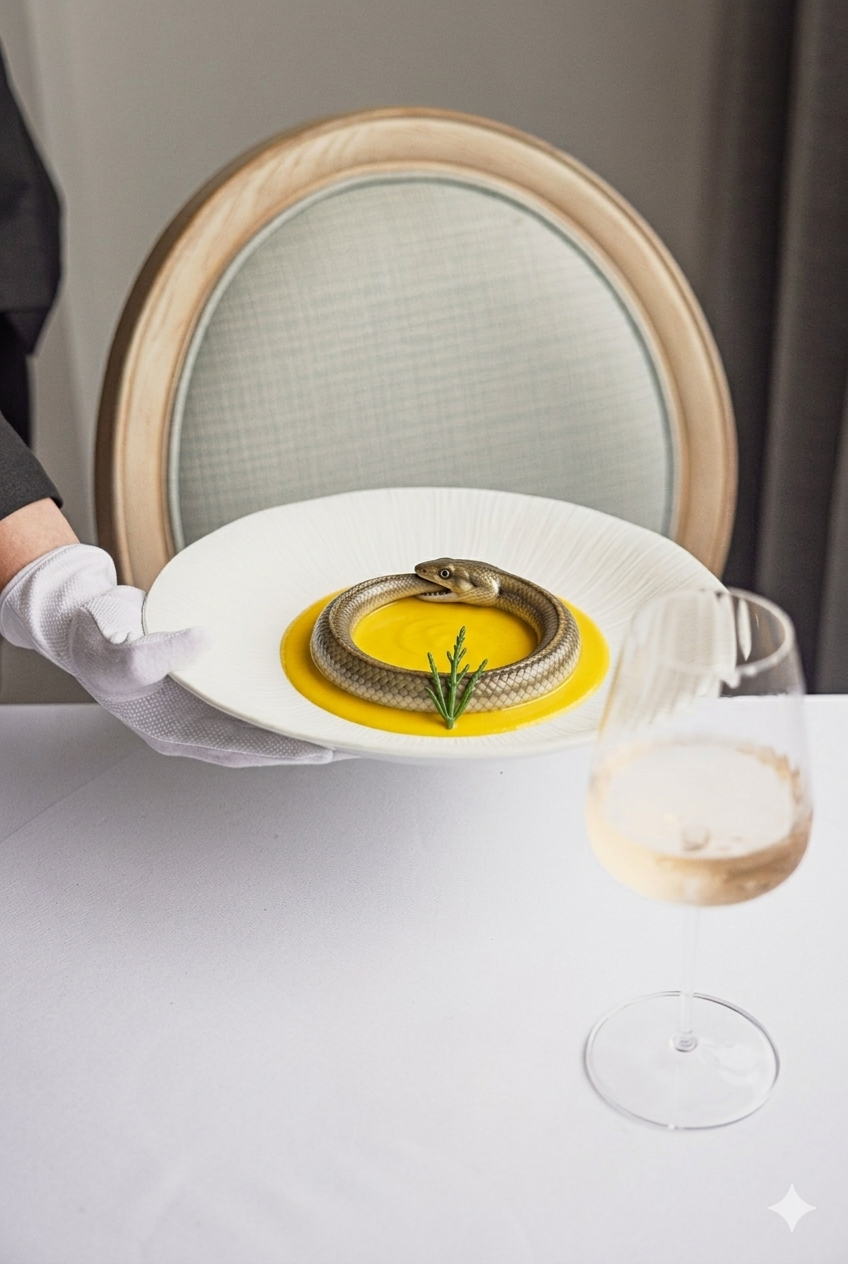
AI-generated variation of a real service photograph, replacing the original dish with a stylised ouroboros, highlighting the shift from reality to constructed imagery.
There is a phrase coming out of the AI world that is worth paying attention to, model collapse. In simple terms, it describes what happens when a system starts learning from material already produced by systems like itself, instead of from fresh human work. The result is not an immediate breakdown. It is more gradual than that. The output remains usable, often polished, sometimes persuasive at first glance, but it becomes narrower, more repetitive, more average. A copy of a copy, then another copy after that.
I have been thinking about that in relation to food photography, because the same drift is easy to recognise once you step back and look at what is happening across hospitality imagery. More content is being produced at speed, more visuals are being assembled from familiar patterns, and more of it feels detached from the reality it is meant to describe. It may still look finished, but it often feels thinner underneath.
That matters because food photography was never only about making things look attractive. It was about making them feel believable. It was about giving shape to appetite, trust and identity. It was about helping a viewer sense that there is something real behind the photograph, something made by someone, somewhere, in a place with its own standards and its own character.
That last part matters more than ever.
One of the weakest habits in visual marketing is treating businesses as categories instead of as individuals. A restaurant becomes just another restaurant. A distillery becomes just another bottle. A bakery becomes just another loaf. Once that happens, the imagery may remain competent, but it stops doing the real job. It stops showing what makes that business different from the next one.
And difference is the whole point.
Every good hospitality business has its own identity. Not in the shallow branding sense alone, but in the deeper way it works, the way it cooks, serves, presents, hosts, plates, pours, wraps, bakes or welcomes. There is a reason one dining room feels more alive than another, one producer feels more serious than another, one hotel feels calmer, warmer or sharper than the one down the road. Those distinctions are not decorative. They are commercial. They are often the reason a customer remembers you, books with you, or chooses you over someone else.
Photography should make that visible.
When it works properly, it does more than show a plate of food or a line of products. It shows this plate, from this kitchen, made with this level of care. It shows this room, with this atmosphere, this light, this way of receiving people. It shows a bottle, a pastry, a menu item, or a chef in a way that belongs to that brand and no other. The aim is not simply to prove that something exists. It is to show why this version of it deserves attention.
This is where the comparison with stock photography becomes useful.
For years, stock images have played a practical role. They are quick, accessible, and often good enough to fill a gap. But they have always carried a limitation that most businesses understand. They are not yours. They show a version of something, not your version of it.
AI imagery is now stepping into a similar role, but with a crucial difference.
Stock photography, even at its most generic, is still rooted in reality. A real shoot took place. Real food was prepared. Real light interacted with real surfaces. Even if the image is not specific to your business, it is still grounded in something that existed.
AI removes that layer entirely.
What you get is not a generic version of your dish, but a statistical interpretation of what that dish should look like. It draws from patterns, not from experience. It produces something that is often visually convincing, yet disconnected from any actual kitchen, service or product.
At a glance, that may not seem like a major issue. The image looks correct. It reads as food. It may even look appealing. But over time, the effect accumulates. As more brands rely on this kind of imagery, the visual landscape begins to level out. Differences soften. Edges disappear. One business starts to look increasingly like another.
That is where the real risk sits.
If your photography stops reflecting what is particular about your business, then your brand begins to lose the very thing that makes it recognisable. Not dramatically, not overnight, but gradually. The work becomes easier to produce, and easier to ignore.
I came to photography after more than three decades in professional kitchens, and that background shapes how I work. Not because it makes for a good story, but because it gives me a different reference point. I understand how food behaves, how quickly it changes, and how much of its appeal depends on timing and handling rather than appearance alone. I know that a dish can look composed long after it has stopped looking good. I know that a photograph can be technically correct while missing the moment that made it worth capturing.
That experience is difficult to translate into a prompt.
A system can reproduce the outline of a dish, the expected colours, the familiar arrangement. What it struggles to hold onto is the specificity of a place, the subtle irregularities that come from real service, and the small decisions that give a business its identity. It tends to move towards what is typical rather than what is particular.
And in hospitality, typical is rarely what you are trying to sell.
At Faydit Photography, my approach has always been fairly restrained. Strip things back, pay attention, and build the image around what is genuinely there. Not to make things look rough, but to make them look true. The aim is to produce photographs that help a business look more like itself, not more like an average version of its category.
This is also why I think real photography may become more valuable as synthetic content spreads. The more the middle of the market fills with smooth, interchangeable visuals, the more useful genuine specificity becomes. People may not analyse it in detail, but they recognise when something feels grounded and when it feels assembled.
I am not anti AI. It has practical uses, and like any tool it can support parts of the workflow. But there is a clear difference between using it to assist the work and using it to replace the act of making something real. Once that replacement becomes widespread, the source of the work begins to thin out.
That is the part worth paying attention to.
Because if fewer real images are produced, fewer new references enter the system. The visual language starts to loop back on itself. And once that loop is established, the work may still function, but it becomes increasingly generic.
The question for hospitality brands is not simply whether an image looks good enough.
It is whether it reflects what makes your business your own.
In a market that is drifting towards approximation, that difference may be the most valuable thing you have.
If you want photography that reflects what is specific to your business, rather than a version of what your business could look like, you can explore my work at Faydit Photography or get in touch to discuss a shoot for website, social media, PR, editorial or print.